
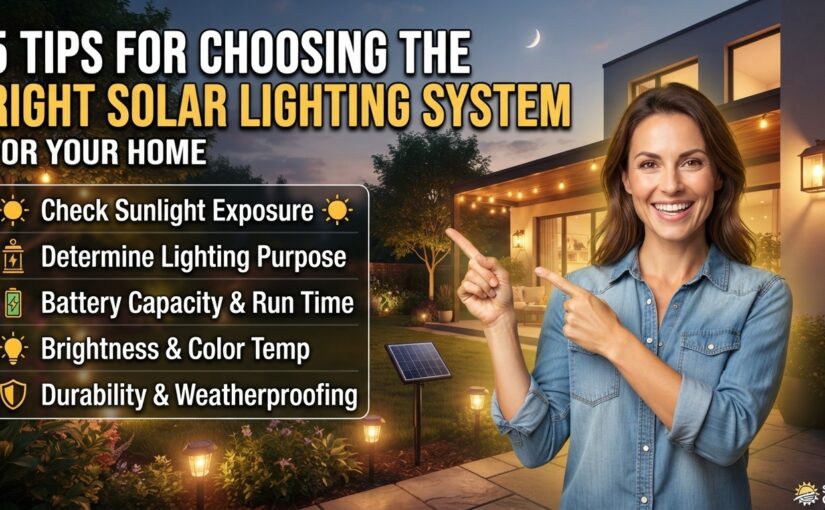
Moving into a new home usually means a long list of half-finished projects, and outdoor lighting tends to sit near the bottom until the first dark evening reminds you it shouldn’t. A Solar Power Lighting System solves that problem in an unbiased, direct way: it lights your driveway, walkway, or backyard using power it collects and stores on its own, so you’re not adding load to your home’s electrical panel or waiting on an electrician’s schedule.
It’s one of the few upgrades that pays for itself in convenience within the first few weeks, since there’s no wiring to schedule and no permit process to sit through before the lights actually work. If you’re weighing your options for a new build, this guide walks through how to choose the right setup, whether it’s actually worth the investment, how it affects your monthly costs, and how much yard space it realistically needs.
Choosing the Right Solar Power Lighting System for a New Home
Not every setup performs the same way, and for a new home, a few decisions early on save a lot of second-guessing later.
Match the light output to the area.
A path light needs far less brightness than a driveway or entryway fixture, so check lumen ratings against the space you’re actually lighting rather than buying one style for the whole property. Overlighting a small garden bed wastes battery capacity that could be better spent on the areas that actually need visibility at night.
Check the battery’s storage capacity.
A unit with a larger battery holds enough charge to get through a stretch of cloudy days, which matters more in regions with inconsistent sun. It’s worth asking how many hours of runtime the battery of solar power lighting system is rated for on a full charge, since manufacturers vary widely on this number.
Look at the mounting style.
Pole-mounted fixtures suit driveways and open yards, while smaller stake lights work better for garden beds and walkways, so the physical setup should match where it’s going. Mixing styles across a property is common and often works better than forcing one design to cover every area.
Confirm the panel’s placement flexibility.
Some systems separate the panel from the fixture, which helps when the ideal light location doesn’t get much direct sun. This is especially useful for new homes with young trees or fencing that will eventually cast more shade than they do today.
Review the warranty on batteries and panels.
These two components wear out before the housing does, so a warranty that actually covers them is worth more than one that only covers the frame. A setup with a two- or three-year battery warranty generally signals better build quality than one that only guarantees the housing.
Is a Solar Power Lighting System a Smart Investment for a New Home?
For most new homeowners, the honest answer depends on how long you plan to stay and how much you value not dealing with wiring. A solar-powered illumination system costs more upfront than a basic plug-in fixture, but it skips the expense of running conduit or hiring an electrician for outdoor circuits, and it has no ongoing electricity cost since it runs entirely on stored sunlight.
Over several years, that combination tends to even out or come out ahead compared to wired lighting, especially in a new build where the electrical work hasn’t been done yet. It’s not the cheapest option on day one, but it’s often the cheaper one by year three or four. For homeowners planning to stay put for a while, that trade-off usually works in their favor, and it’s one worth running the numbers on before committing to either approach.
Can a Solar Power Lighting System Reduce a New Home’s Outdoor Lighting Costs?
Yes, and the savings show up in a few specific places rather than as one lump reduction on a utility bill.
No added electrical circuit costs.
Wiring outdoor lighting into a new home’s panel means additional circuits, conduit, and often permits, all of which add up quickly on a new build’s already stretched budget. A self-powered setup skips that step entirely.
No monthly electricity draw.
Once installed, this kind of setup pulls zero power from the grid, so it doesn’t add anything to your monthly utility bill regardless of how many hours it runs each night.
Lower installation labor.
Without trenching or hardwiring, installation is usually faster, which keeps labor costs down if you’re hiring it out, and many homeowners install smaller units themselves without hiring anyone at all.
Fewer repair calls tied to wiring faults.
Buried or exposed wiring can fail over time, and repairing it often means digging up landscaping to find the break. A solar power lighting system with no wired connection removes that failure point entirely.
Long fixture lifespan with LEDs.
Most systems use LED bulbs, which last significantly longer than incandescent options and need replacing far less often, cutting down on both the cost and hassle of ongoing maintenance.
How Much Space Does a Solar Power Lighting System Need Around a Home?
Less than most new homeowners expect. A single pole-mounted unit typically needs only the footprint of the pole base itself, plus a few feet of clearance so nearby trees, fences, or the house don’t block the panel from direct sun for most of the day. Solar energy lighting doesn’t need a dedicated equipment area or utility access point the way a wired fixture might, since the panel and battery are built into the unit.
For most residential yards, driveways, or walkways, spacing comes down to how far apart you want the light coverage to fall rather than any real space constraint from the system itself. Even smaller lots can usually fit several units without crowding, since each one operates independently and doesn’t need to connect back to a central power source.
Final Thoughts
A Solar Power Lighting System is a practical choice for new homeowners who want reliable outdoor lighting without adding wiring costs to an already long project list. It fits driveways, walkways, and yards without needing much space or ongoing upkeep. If your property gets reasonable daily sun, it’s worth getting a site assessment to map out placement, battery sizing, and fixture count before your first light goes in the ground.