
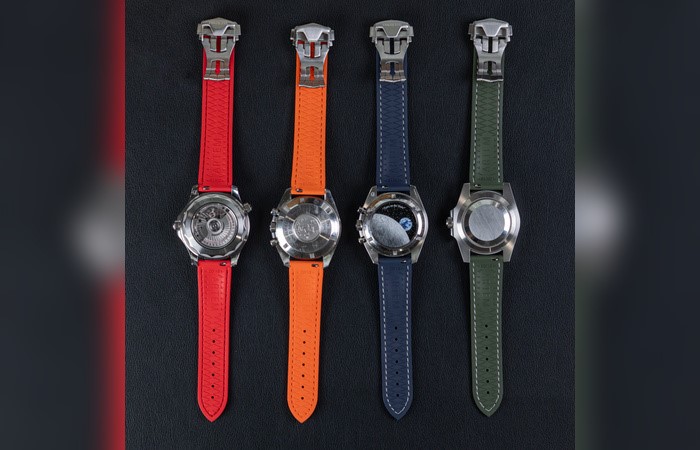
Most strap orders that go wrong go wrong at the first step. The colour is right, the material is right, and the strap arrives a millimetre too wide or too narrow for the gap between the lugs. It either won’t fit at all or sits with a visible gap on each side. Lug width is the one measurement that has to be correct before anything else matters.
This guide covers the six sizes that account for nearly every watch on the market, from 18mm up to 23mm, which watches use them, and what to look out for at each size.
What Lug Width Means
Lug width is the distance between the two lugs on one side of the case, measured in millimetres. It’s also called strap width, band width or lug spacing. A 20mm lug width takes a 20mm strap.
Watches almost always use whole numbers, so the options are 18, 19, 20, 21, 22 or 23mm. Half sizes don’t exist on the watch side, although some straps are made at 19.5mm or 21.5mm to cover two sizes at once.
How to Measure It
Check the manufacturer’s specification first. Most brands list lug width on the product page or in the manual.
If you can’t find it, use a ruler or callipers and measure the gap between the inside faces of the lugs, not the outside. If the number lands between two sizes, it’s almost always the smaller one; a 20.3mm reading means 20mm lugs. Measuring an existing strap at the lug end also works, as long as it fits properly.
18mm
The smallest common size, and the one most often found on vintage watches, small dress watches and compact field watches such as the Seiko 5 SNK series. Many pieces from before the 1980s use 18mm, so it’s the size to check first on anything inherited.
At this width, thin straps look best. A heavily padded 18mm strap can overwhelm a small case, and a taper down to 16mm keeps the buckle in proportion.
19mm
This is the size that catches people out. It looks like a rounding error but it’s used by some very popular watches: the Rolex Oyster Perpetual 36 and Explorer 36, the Omega Aqua Terra 38 and Speedmaster 38, and the Tudor Black Bay 36 all have 19mm lugs.
Because 19mm is less common, the choice of straps is narrower and a lot of generic brands skip it. Don’t be tempted to force a 20mm strap into 19mm lugs; it will bind on the spring bars and wear the strap ends. Some makers offer a 19.5mm strap that fits both 19mm and 20mm, which is a reasonable compromise on nylon but less so on a structured strap.
20mm
The most common size on the market and the easiest to buy for. The Rolex Submariner before 2020, the Datejust 36, the Omega Speedmaster Professional, the Tudor Black Bay 58, the Seiko Alpinist and the Hamilton Khaki Field 38 all use 20mm.
Almost every strap brand makes 20mm in every material, so this is where you’ll find the widest range of tapers, thicknesses and colours. Most 20mm straps taper to 18mm at the buckle, though straight 20/20 versions exist for a sportier look.
21mm
Another odd size that has become more common as brands move to larger cases. The current Rolex Submariner 41 (from 2020 onwards), the Rolex Explorer II 42, the Tudor Pelagos 39 and the Zenith Chronomaster Sport all use 21mm.
As with 19mm, the aftermarket is thinner here. A 21mm strap usually tapers to 18mm at the clasp, so if you’re using a deployant, check the clasp width rather than the lug width. Some brands sell a 21.5mm strap to cover 21mm and 22mm, which works on a pass-through nylon but is not ideal for a two-piece strap.
22mm
The standard size for larger sports and dive watches. The Seiko SKX007 and Turtle, the Tudor Black Bay 41, and the Omega Planet Ocean 43.5 all take 22mm.
Straps at this size tend to be thicker and more padded, which suits the heavier cases they’re made for. The usual taper is 22mm down to 20mm, and rubber and sailcloth are especially well represented here because so many 22mm watches are divers.
23mm
The rarest of the six, and the hardest to buy for. The best-known example is the Tudor Black Bay Bronze 43, and owners of that watch regularly mention how few aftermarket straps exist in this size. Even spring bars can be harder to source.
If you own a 23mm watch, the practical advice is to buy from a maker who lists 23mm explicitly rather than trying to stretch a 22mm strap. A 23mm strap normally tapers to 20mm at the clasp end.
Lug Width Is Not the Whole Story
Once you have the lug width, two more numbers matter.
The first is the clasp or buckle end. Most straps taper, so a strap listed as 20/18mm is 20mm at the lugs and 18mm at the buckle. If you’re fitting a deployant clasp, it has to match the second number, not the first.
The second is length. A strap that’s the right width but the wrong length will still fasten on the last hole. Most makers offer short, regular and long options, so check the wrist measurement guide before ordering.
Where to Find the Odd Sizes
For 18, 20 and 22mm, almost any strap maker will do. For 19, 21 and 23mm, you need a brand that treats those sizes as real options rather than afterthoughts. Artem Straps, for example, offers its Loop-less™ HydroFlex™ range from 18/16mm right up to 23/20mm, including 19/16mm and 21/18mm, which is unusual for a premium strap maker and makes it one of the few places a Black Bay Bronze or an Explorer 36 owner can find a proper fit.
Whichever brand you choose, the rule is the same: measure first, buy the exact width, and match the clasp to the narrow end.