
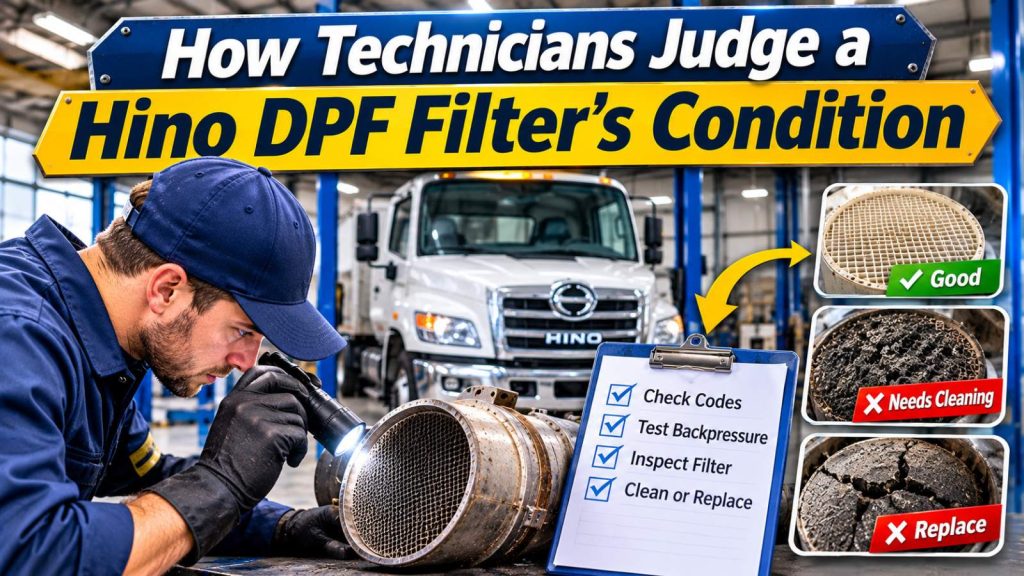
A 2009 Hino conventional rolls past 200,000 miles, and a “DPR Maintenance” message appears in the instrument cluster. The owner’s first question is whether the hino dpf filter in Pennsylvania has to come off. The honest answer is that it depends on what the data says, and Hino’s own service documents lay out a sequence for finding out.
DPF or DPR: what Hino calls it
Hino usually calls its particulate system DPR, for diesel particulate reduction, and some systems add a burner to help regeneration. The filter traps soot, and regeneration burns that soot off. Ash is different. It’s the residue of burned oil and additives, and it stays in the filter until the filter is cleaned off the truck. Hino models differ by year, engine, and emissions configuration, so the manual for your truck decides what applies.
What changes a filter’s condition
Four things matter. Soot loading is the one regeneration handles. Ash accumulates slowly and needs physical removal. Physical damage, such as cracks or melted sections, can follow severe overheating or a failure upstream. And contamination with oil or coolant points to a problem elsewhere in the engine that the filter is paying for.
A fifth category sits outside the filter altogether. Sensors, plumbing, burner components, and software can all produce DPR warnings with a perfectly serviceable filter underneath. That’s why a technician doesn’t start by pulling the filter.
Hino’s own assessment sequence
A Hino tech tip from 2014 for 2008 through 2010 conventional trucks shows how the process is meant to run. Trucks at 200,000 miles may display the “DPR Maintenance” message, and the procedure starts with a diagnostic connection to verify there are no active fault codes in the engine ECU. Any codes get resolved first.
Next comes a manual regeneration through the diagnostic tool to confirm the system works. After a successful regen, the technician runs a differential backpressure check and watches the maximum reading during the test. For those trucks the tip gives a maximum allowable backpressure of 3.3 psi at 2,800 rpm, and a different model year may use different limits. If the reading is under the limit, the message gets reset. If it’s excessive, the filter is removed, cleaned and inspected, and the test is run again to confirm it meets spec. Hino notes that the tip is technical information and not a warranty authorization.
The order matters. Hino DPF filter removal comes at the end of that sequence, after the codes are clear and the numbers say the filter is the restriction.
Inspecting the filter itself
Once the filter is off, Hino’s J08E-VC workshop manual describes a probe inspection. The technician inserts a dedicated check probe from the rear face to inspect the inside, and the result directs them to either clean and reinstall the filter or replace it. Hino has also revised its DPR filter inspection procedure in service information covering 2008 through 2017 model-year trucks, so a shop should be working from the current version, not an old printout.
Visual checks complement that. Cracks, melted or glazed sections, and wet or oil-soaked substrate all change the plan. The final step is the same as in Hino’s tip: retest after cleaning, and don’t return a filter to service on appearance alone.
Cleaning, diagnosis, or replacement
The decision follows the findings. An intact filter that’s restricted by ash or hardened soot is a cleaning candidate. A filter that tests fine while the truck still throws warnings points back to diagnosis of sensors, plumbing, or other systems. A cracked or melted substrate, or one that fails its post-cleaning test, calls for replacement.
A simple clean-or-replace checklist covers the questions worth asking: whether the filter has physically failed, how contaminated it is, how many miles it has, and whether earlier cleanings held. Heavy oil or coolant soaking is the murky one. It may be cleanable in mild cases, and in severe cases the root cause has to be fixed whatever happens to the filter.
Where a shop fits
Professional Hino DPF filter cleaning is the middle path when the filter is intact but loaded. A shop such as 30 Minute DPF Clean lists Hino filters among the ones it services. Whoever does the work, ask for the inspection findings and the before-and-after numbers, and keep them with the truck’s records.
Removal for service is also a very different thing from deleting or bypassing the filter, which violates the federal Clean Air Act and isn’t something this article covers.
What to bring to the shop
Bring the fault history, the regeneration history, the mileage, and whether the DPR maintenance message has appeared. Ask what backpressure or flow numbers the shop uses and where they come from. A shop that can answer in terms of your truck’s model year and Hino’s documents is the one to trust with the filter.